
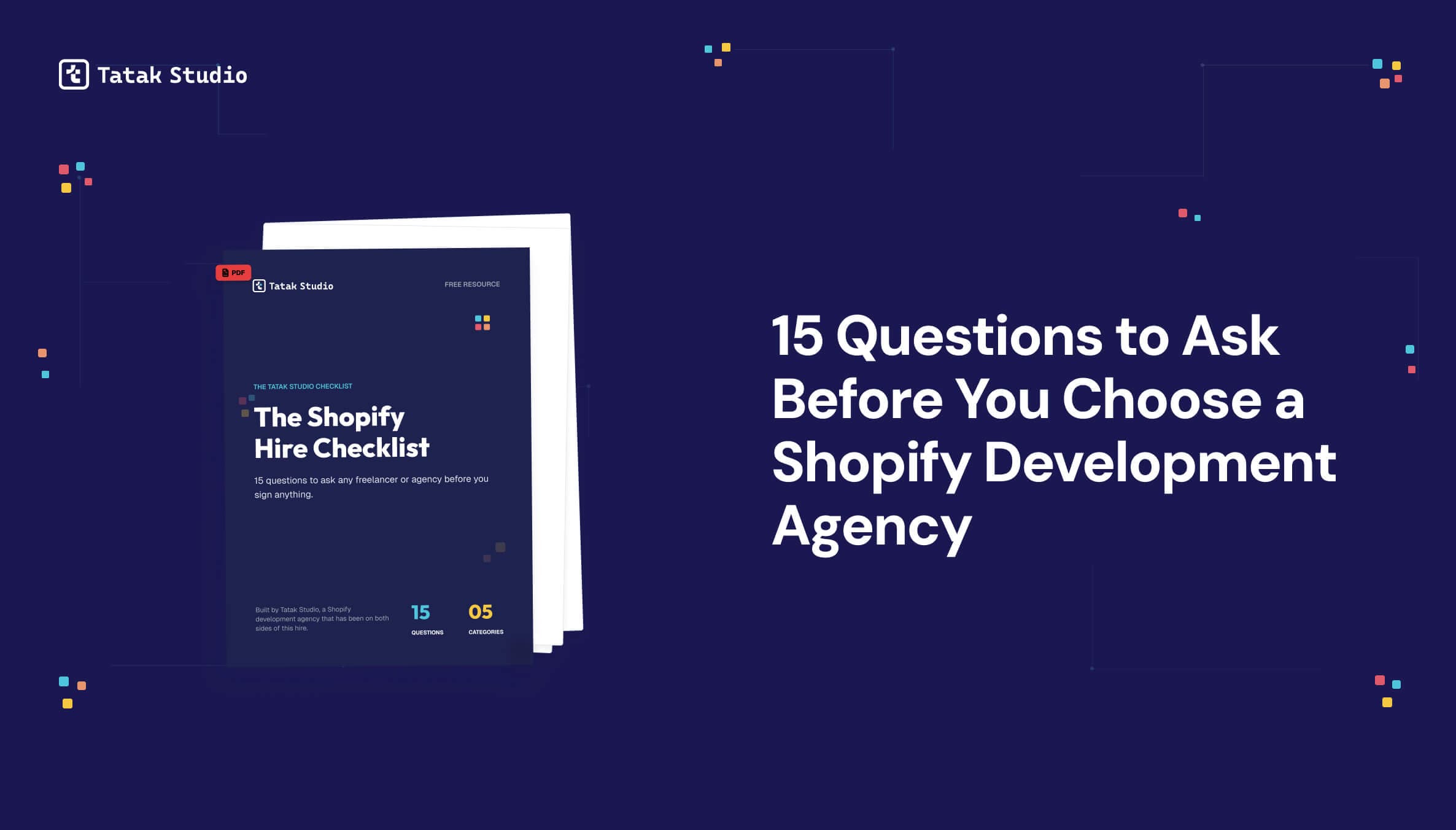
15 Questions to Ask Shopify Development Agencies

Hiring the wrong Shopify developer or agency costs you not only money. It may also cost you time, momentum, and sometimes even your search rankings too.
The frustrating part is that this was likely avoidable. Somewhere in the conversation, there was a vague answer, a dodged question, or a “don’t worry about it” that should have been a red flag.
If you’re new to ecommerce, I’m assuming you don’t know what questions to ask, because building a Shopify store isn’t really your job. It’s ours. So to help you further, we’re listing down the same checklist we’d want you to run through before handing over a Shopify store project to anyone. And yes, that includes us!
If you’re comparing Shopify agencies or vetting freelancers, these are the top questions you need to ask before you work with anyone (based on our experience). We’ve grouped them into five categories, with the red flag to watch for and what a genuinely strong answer sounds like. Ask these questions on your very first call, before quotes and before contracts.
1. Experience & Fit
If you’re speaking with a Shopify dev or agency, the first thing to find out is whether they’ve actually built for businesses like yours.


We’ve built Shopify stores for tech retailers, wine distributors, and dog food & accessories suppliers. A developer who’s only worked with service businesses may not know how to handle a catalog with hundreds of SKUs, and that gap won’t show up until you’re deep into the build.
Ask:
- Have you built Shopify stores in my specific niche or business model before?
- Can I see 1 to 2 live stores you’ve built, not just mockups?
- Have you worked with businesses my size, or mostly much smaller or larger projects?
Red flag: They can’t name or link a single live store they’ve actually built. A portfolio full of static mockups and no working links means you’re their first real client, whether they say so or not.
What a strong answer sounds like: “Here are two live stores in a similar space — one’s a fashion brand, one’s a home goods store, both around your size.” A specific, linkable answer beats a confident-sounding generality every time.
Why this is important: a Shopify developer who’s built for a 5-SKU fashion brand doesn’t automatically know how to structure a 100-SKU electronics catalog, and one who’s only worked with businesses much smaller than yours may not have hit the technical issues that come with your scale yet.
Fit isn’t about finding the “best” developer in the abstract. It’s about finding one who’s solved problems similar to the ones you’re about to give them.
2. Process & Communication
This is where most projects quietly go wrong. Not because the developer can’t code, but because nobody agreed on how the work would actually happen so updates stop coming, deadlines slip, and you find out about problems after they’ve already cost you time.
Ask:
- What does your process look like from kickoff to launch?
- How often will I get updates, and through what channel?
- Who exactly will I be talking to day-to-day?
Red flag: No clear process! If they can’t describe their own workflow in two sentences, they don’t have one, and you’ll be the one chasing status updates for the next two or three months.
A developer with a real process tells you upfront who’s doing what, when you’ll hear from them, and what they need from you at each stage. You shouldn’t be the one holding the whole timeline together in your head.
If you want to see what a documented process actually looks like on our end, read more about it [here]. We break down how we run projects from discovery through launch (and post-launch). It just may be worth a look for context on what a “clear process” should feel like in practice.
3. Technical Scope
This is a category business owners tend to skip because it sounds like a developer-to-developer conversation. It isn’t. These four questions are how you find out whether you’re getting a real Shopify build or a theme with some tweaks and whether your store will survive its first flash sale.
Ask:
- Can you handle custom app integrations, or only theme customization?
- How do you handle third-party apps that conflict with each other?
- What’s your approach to mobile optimization and page speed?
- Do you test on a staging site before pushing changes live?
Red flag: They push changes directly to your live store with no staging environment. One mistake and your storefront is broken for real, paying customers.
This one matters more than it sounds like it should. We’ve integrated a number of custom apps for clients (like payment gateways or delivery platforms without ready-built Shopify plugins).
A theme-only customization is quicker to deliver, but if your business needs custom app logic, real-time inventory syncing across different platforms, or a high-performing build that will not crash when needed, you need to know that upfront, not after launch.
4. Support & Longevity
A store isn’t “done” the day it launches. Shopify stores don’t magically fix themselves nor get you customers. It’s what happens after the launch that’s more important than the launch itself.
Ask:
- What happens if something breaks a week after launch?
- Is there a support period included, and how long?
- If you’re unavailable for a few weeks, is there someone who can step in?
Red flag: “That wouldn’t happen” is not an answer, it’s a dodge. Every build has bugs surface after launch. The question isn’t whether it’ll happen, it’s what happens when it does.
This matters most for solo freelancers, not necessarily because they’re less skilled, but because there’s no backup plan if they get sick, get busy with another client, or simply move on. Agencies aren’t automatically better here, but a team structure at least means your project doesn’t disappear if one person goes quiet.
At Tatak Studio, we include 30 days of post-launch support, and any critical bugs get fixed within 24 to 48 hours at no extra cost. To help you get your first hundred customers, we also offer full-suite marketing services, that include a la carte services like SEO and Content Marketing, Branding, and Social Media and Paid Ads Management.
5. Cost & Contract
Never skip this.
This is where a quote that looked great on paper quietly turns into a much bigger bill once you’re already committed.
Ask:
- Does your quote include QA and revisions, or are those extra?
- What’s not included in this price that I might need later?
Red flag: The quote looks great until you realize QA, revisions, and basic support are all billed separately, on top of the number you were quoted.
For us at Tatak Studio, QA and 3 rounds of revisions are all included. Anything beyond that, like new feature requests and third-party app fees, we’ll need to scope and quote separately, so there are no surprises.
Don’t Fall for the Pitch!
Here’s one rule that matters more than any single question on this list: watch how they answer, not just what they say. A vague response, a defensive reaction, or no answer at all is information too.
A developer, freelancer, or agency worth hiring should be able to answer all 15 of these without hesitation because they would have already thought about these questions before.
If these get a shrug, a “we’ll figure it out,” or a change of subject, that’s your answer. Better to find out on the sales call than three weeks into a broken build.
All 15 Questions for Shopify Developers in One Place

Save or screenshot this list before your next call:
Experience & Fit
- Have you built Shopify stores in my specific niche or business model before?
- Can I see 2 to 3 live stores you’ve built, not just mockups?
- Have you worked with businesses my size, or mostly much smaller or larger projects?
Process & Communication
- What does your process look like from kickoff to launch?
- How often will I get updates, and through what channel?
- Who exactly will I be talking to day-to-day?
Technical Scope
- Can you handle custom app integrations, or only theme customization?
- What’s your approach to mobile optimization and page speed?
- Do you test on a staging site before pushing changes live?
Support & Longevity
- What happens if something breaks a week after launch?
- Is there a support period included, and how long?
- If you’re unavailable for a few weeks, is there someone who can step in?
Cost & Contract
- Does your quote include QA and revisions, or are those extra?
- What’s not included in this price that I might need later?
Why We’re Comfortable Being on the Other Side of This List
We built this checklist from our own experience being hired. We ask ourselves the same standard we’re asking you to hold anyone else to.
That means real answers, not sales language: yes, we can show you live stores (and we tell you if we don’t have one). Yes, we test everything on staging before it touches your live site. Yes, there’s a defined support period after launch, with real timelines attached to it. And when we quote a project, we tell you what’s included and what isn’t before you sign anything, not after.
If you’re currently comparing quotes, or you’ve already got one that’s making you a little uneasy, the fastest way to get clarity isn’t to re-read the contract for the nth time. It’s to ask someone who isn’t trying to win your business to look at it with you.
People Also Ask…
Should I choose a freelancer or an agency? Neither is automatically the right answer. Plenty of freelancers do excellent work, and plenty of agencies overpromise. Use these 15 questions on either, and let the answers decide, not the label on the invoice.
What’s a reasonable price for Shopify development in the Philippines? It depends heavily on scope but we broke it down (and included how we price projects) in this article. Shopify theme customizations and a fully custom Shopify store with integrations aren’t the same job, and shouldn’t cost the same. This is exactly why Question 15 (“what’s not included in this price”) matters more than the headline number on any quote.
Ready to Put This Checklist to Work?
You don’t have to run through all 15 questions alone. Book a free discovery call and we’ll walk through your project, your quotes, and your options with you. No pressure, no jargon, and no obligation to work with us afterward.
Book a Free Discovery Call → Free · No obligation · We reply within 24 hours