
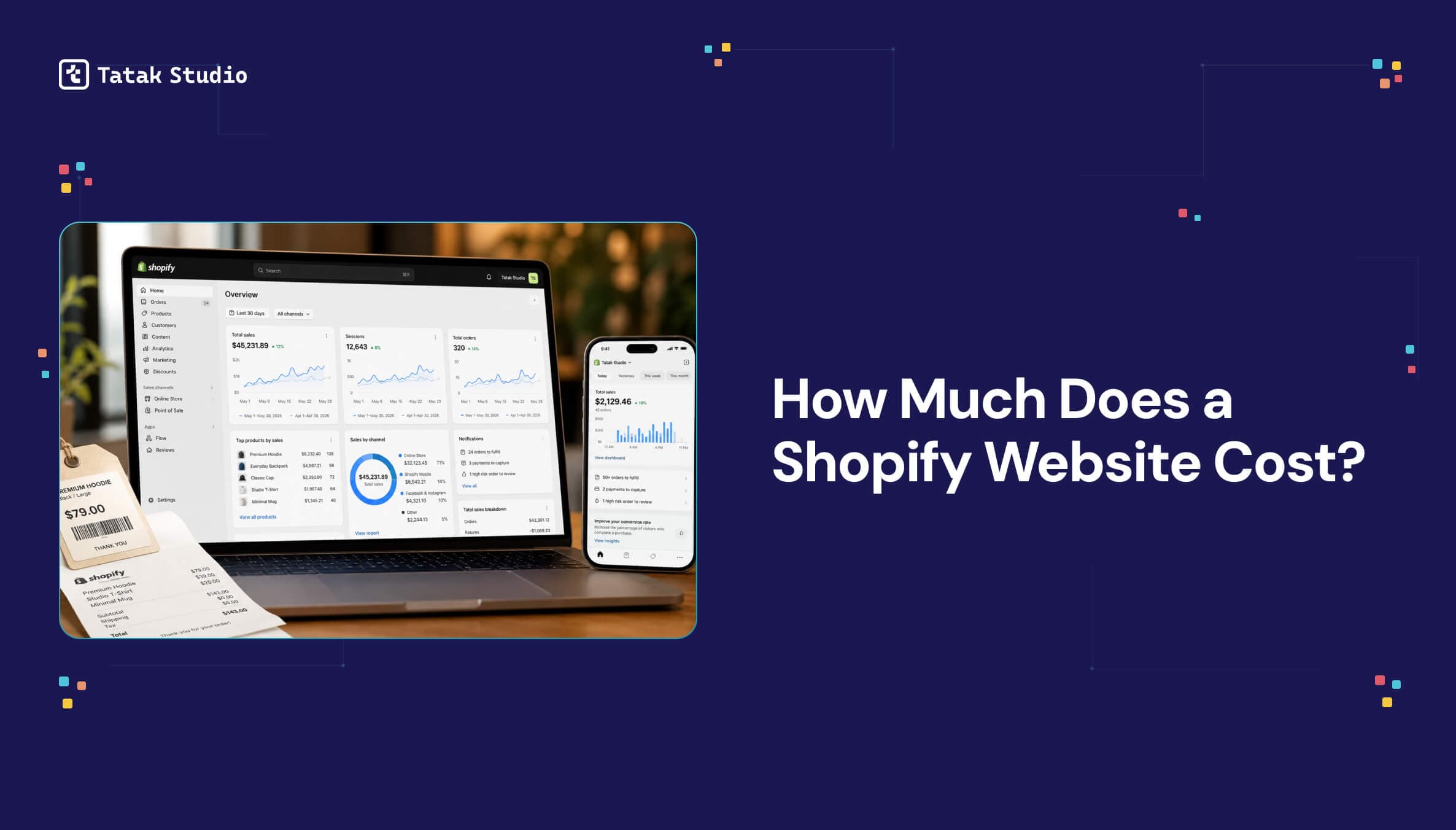
How Much Does a Shopify Website Cost in 2026?

One agency says ₱80,000. Another says ₱400,000. Then, a freelancer from Upwork sends a DM saying he can build your Shopify store for ₱15,000.
So, who’s right?

The truth is, all of them could be!
But today, we’ll help you identify what’s real and what’s not in Shopify development. We’ll talk about Shopify’s own fees, design and development costs, apps, maintenance, and any other hidden costs so you know exactly what you’re paying for and why. We’ll also show you how we price Shopify websites in 2026.
By the end, you’ll have a realistic number to work with, and if you want us to build it for you, we’ll tell you what that looks like too.
The Two Kinds of “Shopify Cost” You Need to Separate
Before we go further, there’s one confusion we clear up on almost every discovery call: Shopify’s subscription fee and your Shopify development/setup cost are two completely different things.
Shopify the platform charges you rent for using their infrastructure. This includes servers, checkout, security, hosting, and anything else a Shopify store may need to keep operations running smoothly. That’s a fixed, published price.
Shopify development is the cost of actually building your store on top of that platform. This includes the design, the product setup, the custom features, the setup of apps, the testing, and all the work that turns an empty Shopify account into a store that sells.
Shopify Platform Fees

As of July 2026, Shopify runs on four main plans:
- Basic starts at $19/month, and is built for businesses just getting started, with 2% third-party payment provider rates.
- Grow starts at $49/month, aimed at small teams, with lower 1% third-party rates and up to 5 staff accounts.
- Advanced: starting at $299/month, for businesses selling globally, with 0.6% third-party rates, up to 15 staff accounts, and live third-party shipping rates.
- Plus: starting at $2,300/month on a 3-year term, built for complex, high-volume businesses, with a fully customizable checkout, unlimited staff accounts, and B2B/wholesale selling.
Shopify also takes a transaction fee on every sale unless you’re using Shopify Payments exclusively. When you use a payment gateway other than Shopify payments like Paypal or a local Philippine-based payment gateway, you’ll be charged with a 0.6% to 2.0% third-party payment gateway rate.
This means that if you’re using Xendit as your main payment gateway (instead of Shopify Pay) and are on the Basic plan, you’ll be charged with:
2.0% (Shopify) + 0.5% (Xendit partner fee) + ~2.9% + ₱15 (Xendit processing) ≈ 5.4% + ₱15 per transaction

So for example, one of our clients sells wines and spirits. If a customer purchased an 1800 Anejo at the SRP of ₱3,380.00. Your total fees for that transaction amounts to roughly ~₱197.

For Tatak Studio clients who are small- to mid-sized, we recommend the Basic or Grow subscription. You don’t need Shopify Plus until you’re moving real enterprise-level volume.
Shopify Development Cost: The Part Most Quotes Actually Cover
This is where the real differences lie. We categorize Shopify development into 3 simple categories:
A Simple, Template-Based Store
This is the best for entrepreneurs who want to dive into ecommerce but with a tight budget. If you have a handful of products, a clean Shopify theme, and basic branding, this fits your requirements. This usually involves:
- Picking and customizing a pre-built theme
- Setting up your product catalog, collections, and categories
- Basic branding (logo, colors, fonts already provided)
- Payment gateway and shipping setup
- A handful of essential apps (reviews, email capture, basic SEO)
We’ve seen businesses spend months polishing features customers never use. We’d rather see you launch in weeks, make your first sales, and let real customer data shape the next version of your store.
You don’t have to get everything right from day one: every premium app, custom feature, and advanced integration. Just keep things simple to launch faster, gather real customer feedback, and invest in improvements once you know what’s actually working.
The goal isn’t to build the perfect Shopify store on day one. It’s to build one that’s good enough to start selling. You can always iterate as your business grows.
Template Installation Service Fees: $250 – $500 or ₱15,000 – ₱30,000
A Custom-Built Store

This is where most brands land. Instead of a store that looks like every other Shopify store in your industry, you get a design built around your actual brand. You get custom homepage sections, product page layouts designed to convert, mobile-first UX, and stronger on-page SEO structure from day one.
This usually includes:
- Custom UI/UX design (not just a theme with your logo slapped on)
- Development of custom sections and templates
- Conversion-focused product and collection pages
- App integrations for things like loyalty programs, subscriptions, or upsells
- On-page SEO setup so the store isn’t starting from zero on Google
We consider this the sweet spot for businesses who are ready to look and perform like a real brand and not just a weekend project.
Custom Design & Build Service Fees: $800 – $2,000 or ₱50,000 – ₱100,000
A Complex, Custom-Built Store
Bigger catalogs, multi-currency or multi-language setups, custom checkout flows, ERP or inventory system integrations, headless builds, or highly specific functionality that no app on the App Store quite solves. This is where Shopify development starts looking more like custom software development.
Expect this to involve:
- Custom app or API development
- Complex third-party integrations (CRM, inventory, POS, accounting systems)
- Performance and scalability work for high-traffic stores
- Ongoing technical architecture decisions, not just design choices
For instance, we recently helped a client link their Shopify storefront with an external ERP system used for inventory management. This process involved a complete review of the ERP documentation to correctly connect it with the Shopify store.
Custom Design & Build Service Fees for Complex Sites: $2,000+ or ₱101,000+
What Actually Drives Your Shopify Development Cost Up or Down

Regardless of which you fall under, these are the factors that move the number:
- Number of SKUs (products) and how complex your catalog is (variants, bundles, subscriptions all add setup time)
- How custom the design needs to be vs. how much you’re okay using a theme as-is
- Number of third-party integrations: every extra system you connect adds development and testing time
- Content readiness: if you don’t have product photos, copy, and branding ready, expect either delays or added cost to produce them
- Migration: if you’re moving from Wix, WooCommerce, or another platform, migrating products, SEO rankings, and customer data adds real work
- Ongoing app subscriptions: most stores run 3 to 8 apps for things like reviews, email, upsells, and analytics, and these usually run anywhere from a few hundred to a few thousand pesos a month combined
The Hidden Costs Nobody Mentions Upfront
A few things that quietly get left out of cheaper quotes, and that we make sure are accounted for from the start:
- Apps and their monthly fees: a store isn’t done just because it launched; the apps that make it convert keep charging monthly
- Theme licenses if you go the template-route and a premium paid theme instead of a free one
- Ongoing maintenance: Shopify updates, app conflicts, and small fixes don’t stop after launch
- SEO and content: a beautiful store with zero SEO foundation won’t show up on Google, and that’s a separate (crucial) investment
- Post-launch support: someone needs to actually manage the store, answer “why isn’t this button working” questions, and keep things running
This is usually forgotten but it should be planned before going in and building the Shopify store.
So, What’s a Realistic Shopify Store Development Cost in 2026?
Obviously, the price range varies but to give you an idea of what we charge as a Shopify development agency in the Philippines, we’re breaking down what we include as part of our deliverables for a five-product Shopify development project. We divide our deliverables into four areas:
Foundation & Strategy
- Kickoff Call to align objectives and launch the overall construction process
- Sitemap and Information Architecture Development: Mapping out the structure, collections, and categories of your store to establish a clear navigation and strong user experience
- Domain Setup: Safely connecting and configuring your custom brand domain to operate on top of Shopify’s platform infrastructure
- Google Analytics + Google Search Console Setup: Configuring proper tracking tools from day one to build a reliable on-page SEO foundation so your store can eventually show up on Google
- Shopify Store Setup: Building the essential infrastructure of your core store account and integrating basic branding assets like your logo, colors, and fonts
- Payment Gateway Setup: Integrating third-party providers such as PayPal or local payment gateways like Xendit, while optimizing for transaction fees and processing rates
- Shipping Configuration: Establishing your delivery rules, zones, or third-party shipping rates based on your business volume and specific platform plan tier
- Product Uploads: Initial catalog setup and handling of your SKUs for a five-product project.
Shopify Design, Build, & Performance
- Design Concepts: Two (2) custom design concepts to identify and approve a visual direction for your Shopify store
- Rounds of Revisions (Design Phase): Three (3) free rounds of revisions to refine and approve visual layouts before moving into development
- Number of Pages and Templates (includes Shop, Category/Collection, Cart & Checkout Pages): Design and development of 5 unique pages along with essential e-commerce layouts including Shop, Product, Category/Collection, and Cart pages
- Stock Photos, Icons, Illustrations: Full inclusion of relevant premium stock media assets, custom icons, and illustrations for your Shopify store when an internal asset bank is unavailable
- Content Management System (CMS) Configuration: CMS setup to manage blog posts and internal pages easily, allowing you to execute content marketing strategies to get your site discovered
- Custom Theme Development: High-performance, conversion-optimized theme development built based on UX best practices
Visibility & Content Growth (SEO + Content)
- Page Copy Development: Strategic copy development for core website pages to clearly communicate your value proposition and reflect your brand voice
- On-page SEO: Complete optimization including structural keyword integration, tailored title tags, meta descriptions, and descriptive image alt tags across pages to build strong search discoverability from day one
Reporting, Support, & Maintenance
- Handover Session/Training Session (recorded): A recorded 1-on-1 walkthrough training session to empower your team to add new products, edit listings, swap assets, and publish blogs independently
- Support: 30 days of post-launch technical assistance to track store stability and handle immediate operational requirements after going live
- 30-Day Report: Detailed report covering site health metrics, full SEO analytics, and clear, actionable growth recommendations
- Support Type: Direct assistance via dedicated email and chat channels for troubleshooting, minor fixes, and configuration questions
Generally, giving one number without knowing your design and integration needs would be impossible. But for you to properly understand how projects are priced, it helps to see a concrete example. Our quote for this particular client was US$2,000 for the Shopify store development.
Let’s Figure Out Your Actual Number
If you’ve read this far, you’re clearly serious about getting this right. You know that you’re not just launching a store, but building one that actually sells and keeps selling.
The fastest way to get a real, accurate Shopify development cost for your business is a quick discovery call. We’ll walk through your products, your goals, and what you already have in place, and give you a clear breakdown. No generic packages, no upsell pressure.